Insulated concrete forms in Evergreen, CO give mountain homeowners a wall system built for wildfire exposure and brutal temperature swings, not just another framing upgrade. After years pouring foundations and flatwork across Evergreen's rocky, high-elevation lots, we've seen which wall systems hold up through freeze-thaw cycles and which ones start cracking by year five. Here's what ICF actually costs, how it's built, and whether it can move the needle on your insurance bill.
What Are Insulated Concrete Forms in Evergreen, CO?
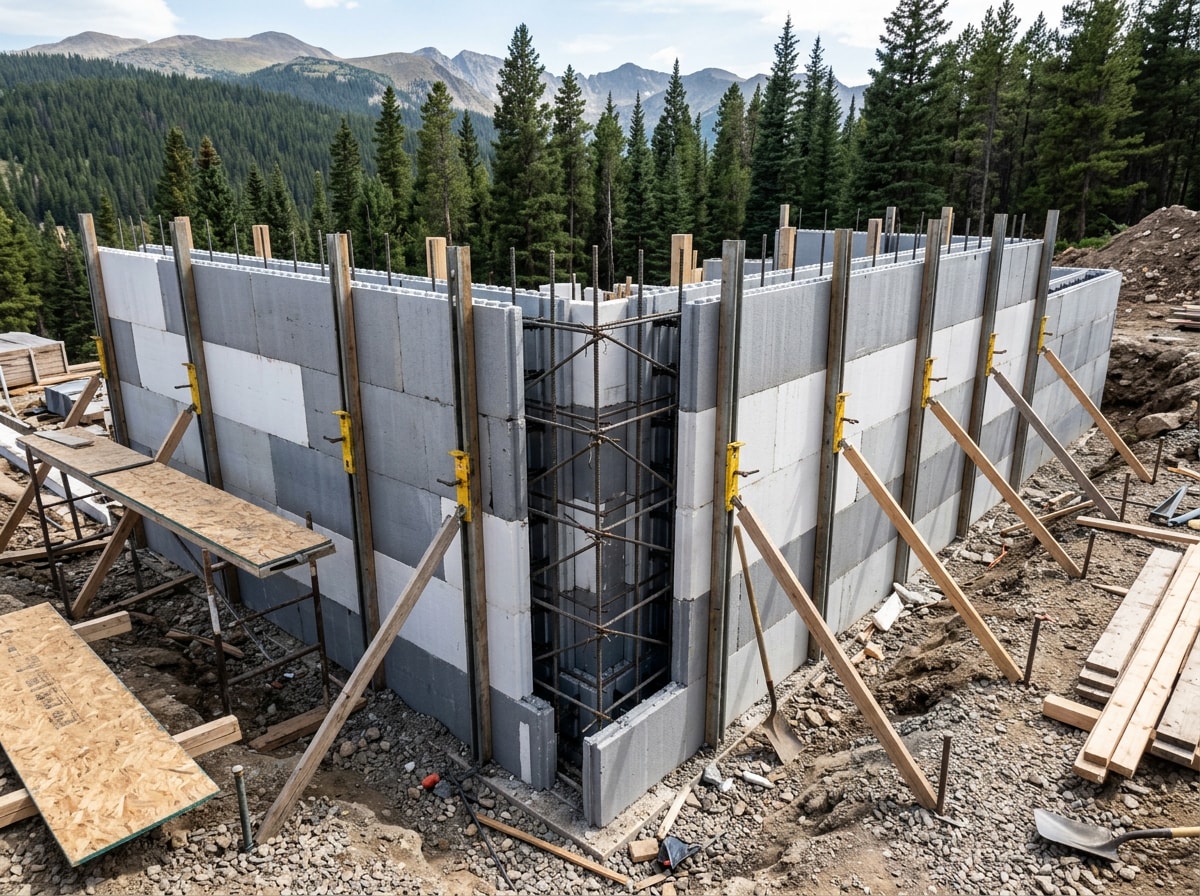
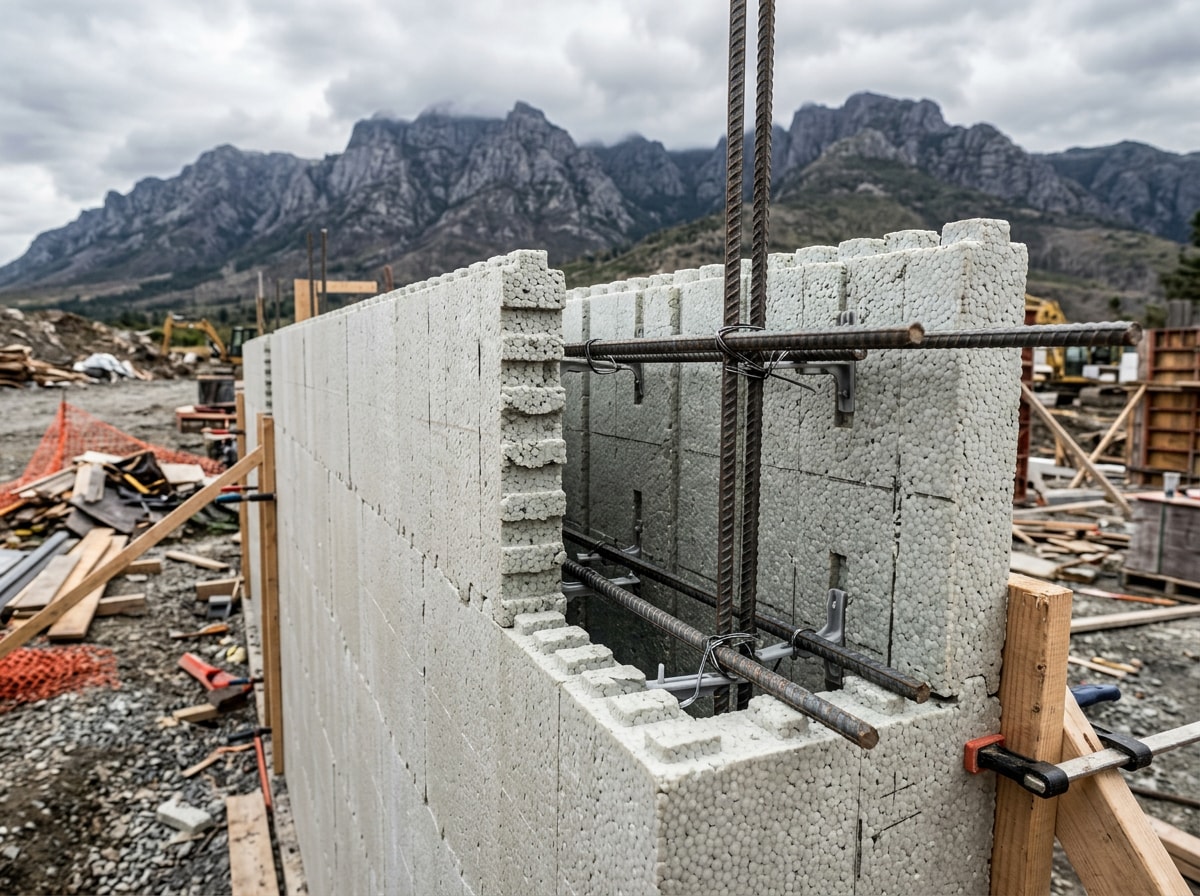
Insulated concrete forms, or ICF, are hollow foam blocks that stack like oversized Legos, get reinforced with steel, then get filled with poured concrete to create a solid, insulated wall in one step. The foam stays in place permanently. It acts as both the concrete form and the building's insulation layer. Homeowners generally encounter ICF in two forms: full-envelope construction or foundation-only applications.
ICF Homes
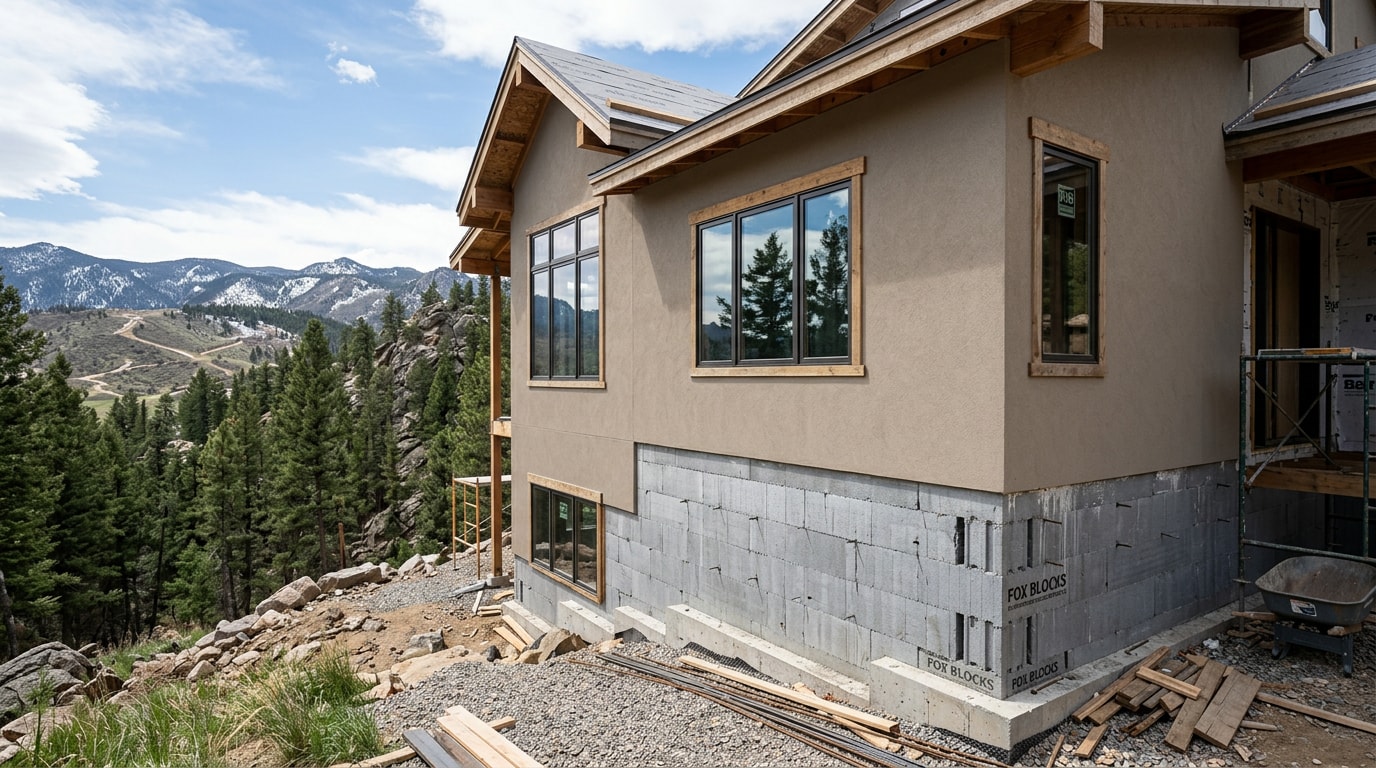
Full ICF construction extends the system from the foundation to the roofline. The entire shell of the house is built from insulated concrete instead of switching to wood framing above grade. For mountain homes, this matters most where fire rating and energy performance intersect. A continuous concrete envelope resists ember intrusion better than wood framing, and it holds heat more consistently through Evergreen's wide temperature swings.
ICF Foundations
Some homeowners aren't ready to commit to a full ICF shell. They start with ICF foundations instead, using the system below grade while framing the rest of the house conventionally. This is a lower-cost entry point that still delivers real benefits. At Evergreen's elevation, freeze-thaw cycles stress conventional poured foundations over time, and the added insulation layer in ICF walls helps resist that cracking while keeping basements warmer and drier. Our concrete installation crews pour both conventional and ICF foundations across these lots, so the right call usually comes down to your soil report and budget.
The Colorado Mountain Insurance Picture
Colorado insurers have pulled back in a number of wildfire-exposed mountain neighborhoods over the past several years, and that pressure has pushed more homeowners to ask whether their wall system affects underwriting at all. A Colorado State University analysis found that statewide homeowners insurance premiums rose 58% between 2018 and 2023, driven largely by wildfire risk, with nonrenewal rates running highest in the state's most exposed areas.
A noncombustible structure doesn't guarantee a lower premium. It does give insurers a different risk profile to evaluate, which can matter in areas where coverage has become harder to secure at any price. Insurance credits and underwriting rules vary by carrier, change often, and are never something a builder can promise on your behalf. What's consistent is the broader trend documented by Colorado State University's wildfire insurance research: mountain communities are facing rising premiums and nonrenewals, which is part of why noncombustible construction keeps coming up in these conversations.
If you're building or rebuilding in the area, request a free estimate and we'll walk through what your lot and insurance situation actually call for, not a generic sales pitch.
How an ICF Wall Is Actually Built
The process is more straightforward than most homeowners expect:
- Crews stack interlocking foam blocks course by course.
- Steel rebar slides into the hollow cores for structural reinforcement.
- The wall is braced to hold its shape during the pour.
- Concrete fills the forms in controlled "lifts" so it fills evenly without blowing out the blocks.
The result is a single wall that's structural, insulated, and air-sealed all at once. That continuous insulation matters more here than at lower elevations. Evergreen's heating-degree-days run well above Denver's, so a wall system that doesn't rely on separate insulation batts, which can settle or gap over time, keeps performance consistent through harsher winters. Builders reference current structural and fire standards for ICF assemblies through ICC-ES code evaluation reports during permitting, which is worth asking about before you sign a contract.
Benefits of ICF Construction
ICF walls typically outperform standard wood framing on energy efficiency, wind resistance, mold and rot resistance, and sound dampening, while also reducing dependence on lumber supply swings. The clearest way to see the difference is side by side:
| Factor | ICF Wall | Standard Wood Framing |
|---|---|---|
| Nominal R-value | R-17 to R-28 | R-13 to R-21 |
| Fire rating | Typically 2-4 hours | Roughly 30-60 minutes |
| Sound transmission (STC) | 50+ | 30-35 |
These aren't marginal gaps. A noncombustible, continuously insulated wall changes how a house performs in a wildfire-adjacent neighborhood and how quiet it feels during a windstorm. The U.S. Department of Energy classifies ICF among the structural systems that build insulation directly into the wall assembly, rather than adding it as a separate layer, which is part of why the continuous-insulation argument holds up across climate zones. For a side-by-side look at how another Colorado market handles the same system, see our ICF guide for the South Denver Suburbs.
Cost, Build Time, and What Surprises Homeowners
ICF costs more upfront than standard framing, but the premium is driven less by the forms themselves and more by labor familiarity, wall complexity, and finish choices. Build-time comparisons are similarly nuanced. ICF walls can go up faster than framing, insulating, and air-sealing done as separate steps, but weather, crew experience, and design all swing the timeline either way.
Two misconceptions come up constantly:
- ICF homes don't look like concrete bunkers. Once finished, interior and exterior surfaces look identical to any other home.
- ICF isn't limited to full custom builds. It pencils out for additions, garages, and foundation retrofits where the long-term performance gain outweighs the modest upfront cost difference.
If you want a straight answer on what a specific wall or foundation would run on your lot, our team can walk the site and price it out. Get a free estimate before you lock in a framing plan. You can also see our full range of concrete and hardscape work on the home page, and check our Evergreen service area page for notes on local permitting and typical lot conditions.
FAQ
How much does ICF construction cost in Evergreen, CO?
ICF generally runs higher per square foot than standard framing, with the exact premium shaped by finish level, site access, and design complexity. Most mountain projects see their biggest cost swings from custom features rather than the ICF system itself. Expect a meaningful premium over wood framing; an on-site estimate is the only way to get a real number for your lot.
How long does an ICF home take to build?
Timelines run close to conventional framing overall, though the wall-building phase often moves faster since insulation and structure go up in one step. Weather, crew availability, and design complexity still drive the final schedule.
Can ICF be used for garages and additions, not just full homes?
Yes. ICF works well for garages, accessory dwelling units, and additions, not just full custom homes. It's often a practical way to test the system on a smaller structure first.
Does ICF construction affect wildfire insurance in a Colorado mountain community?
It can factor into underwriting, but it isn't a guaranteed discount. A noncombustible wall assembly changes the risk profile insurers evaluate, which matters in areas where carriers have been non-renewing policies. Ask your agent directly how your carrier treats construction type before assuming any specific savings.
What R-value does an ICF wall actually provide?
Manufacturers commonly rate ICF walls between R-17 and R-28, but that's a nominal number. Ask your installer for tested, not just rated, performance figures, since real-world results depend on block thickness and installation quality.
Is ICF worth it for a mountain home in Evergreen?
For full builds or rebuilds in wildfire-exposed, high-elevation areas, the fire resistance and consistent insulation often justify the added cost. For smaller projects like a foundation or garage, it's worth pricing both systems side by side before you decide. Contact us and we'll help you compare the two for your specific project.