If you're staring at a materials list and wondering how many bags of concrete fit on a pallet before you call for delivery, the count depends entirely on bag weight. Standard pallets follow a predictable pattern across every major brand sold in East Metro & Castle Rock, CO, and knowing it before delivery day keeps your job site, your forklift, and your budget on track.
Standard Pallet Counts by Bag Size
Pallet counts are built around a weight ceiling, not a bag ceiling. Heavier bags mean fewer bags per pallet; lighter bags mean more. Here's the quick-reference breakdown.
| Bag Weight | Bags per Pallet | Total Dry Weight | Approx. Yield |
|---|---|---|---|
| 40 lb | 80 | ~3,200 lb | ~24 cu ft (0.89 yd³) |
| 50 lb | 64 | ~3,200 lb | ~24 cu ft (0.89 yd³) |
| 60 lb | 56 | ~3,360 lb | ~25.2 cu ft (0.93 yd³) |
| 80 lb | 42 | ~3,360 lb | ~25.2 cu ft (0.93 yd³) |
Every configuration lands near the same total weight because pallets are engineered around a forklift-safe load limit, not a round bag number.
80 lb Bags per Pallet
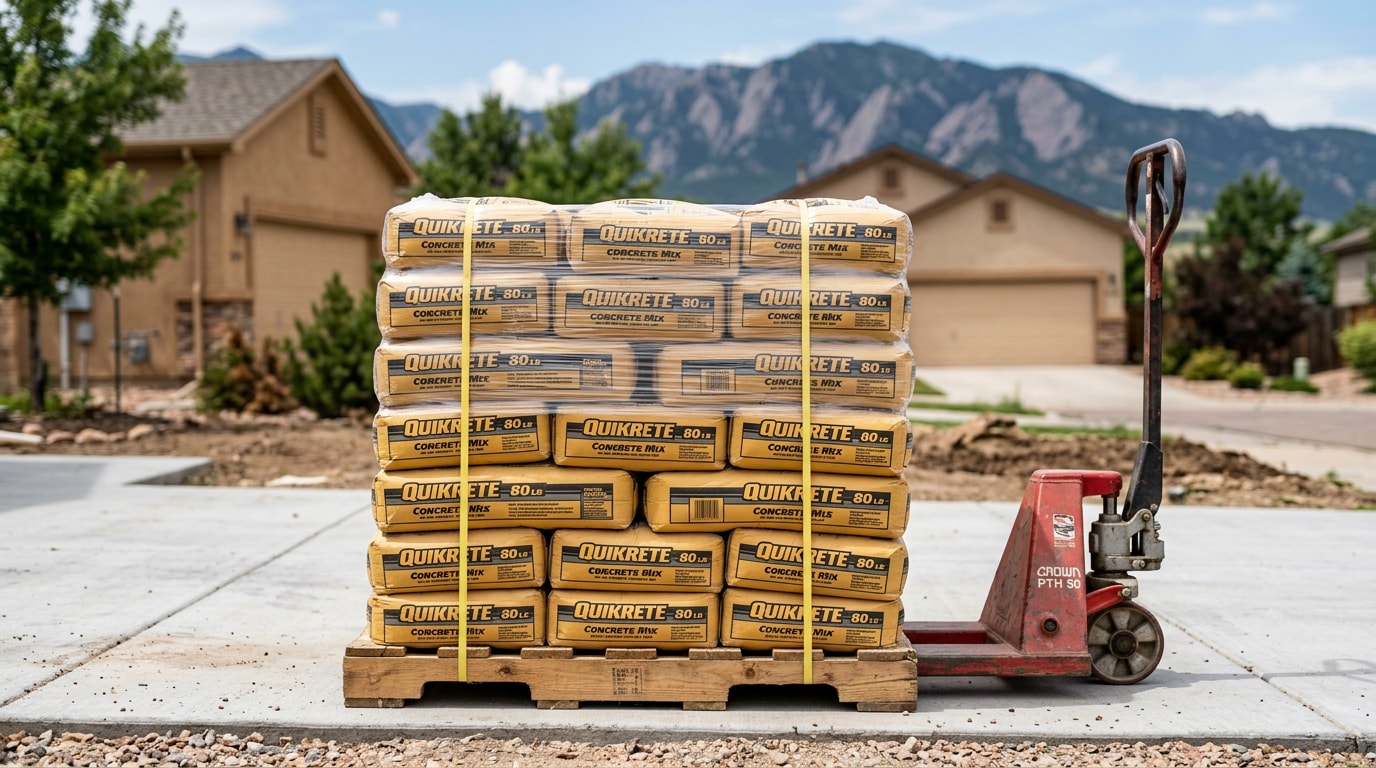
A standard pallet holds 42 bags of 80 lb concrete mix, for roughly 3,360 lbs total. This is the most common configuration for footings, foundations, and slabs over two inches thick.
An 80 lb bag yields about 0.60 cubic feet of mixed concrete, which is the figure Quikrete publishes for its standard Concrete Mix #1101 product line . That puts a full 42-bag pallet just under one cubic yard, close enough that most contractors round up to one pallet plus a few loose bags for a true one-yard pour.
60 lb Bags per Pallet
A pallet of 60 lb bags typically holds 56 bags, bringing total weight to about 3,360 lbs, nearly identical to the 80 lb configuration. The lighter individual bag makes 60 lb mix a popular middle ground for DIYers who want manageable lifting without giving up much coverage per bag.
Crews we work with around Castle Rock often prefer 60 lb bags for post holes and small footings, where consistent, smaller pours matter more than raw bag count.
50 lb and 40 lb Bags per Pallet
Lighter bags are packaged in higher counts. 50 lb bags commonly run 64 per pallet, and 40 lb bags typically run 80 per pallet. Both totals keep the pallet in roughly the same overall weight range as the heavier configurations.
Not every specialty mix is sold in every bag size. Quikrete's 5000 High Early Strength mix, for example, is available in 50 lb, 60 lb, 80 lb, and 30 kg bags , with no 40 lb option listed. If you're ordering a high-early-strength or crack-resistant mix for a Castle Rock footing in cold weather, check the specific product's data sheet before assuming a 40 lb bag exists.
Specialty Mixes and Pallet Count Variations
Not every bagged product follows the standard 42- or 56-bag math. Non-shrink grout, sand topping mix, Type S and Type N mortar, and concrete resurfacer are packaged by volume and application, not a uniform count. A pallet of specialty mix can run anywhere from the mid-40s to the high 80s in bag count depending on the formula's density.
If you're not sure which count applies to your project, the safest move is to check the pallet tag or the product's technical data sheet before you order, since the same brand name can ship different counts depending on the specific mix.
Pallet vs. Ready-Mix: When to Switch to Truck Delivery
Bagged concrete works for small jobs, but the math changes fast on larger pours. A 20x20 patio needs roughly four cubic yards of concrete, close to five full pallets of 80 lb bags. Hand-mixing that volume realistically takes a two-person crew most of a day, with real risk of cold joints forming as earlier sections start setting before later ones are poured.
A ready-mix truck delivers that same volume in minutes, already mixed to consistent strength, often for similar or lower total cost once labor is factored in. As a rule of thumb, ready-mix starts winning once a project crosses the one-to-two cubic yard mark. Pallet delivery still makes sense for phased work or tight-access lots where a truck can't reach, which is common on older infill lots around Castle Rock.
If you're not sure which approach fits your project, get a free estimate and we'll walk through the numbers before you commit to a pallet count or a truck.
Cold Weather, Freeze-Thaw, and Pallet Choice
East Metro & Castle Rock sees real freeze-thaw cycling in spring and fall, and that affects which mix belongs on your job site, not just how many bags come on the pallet. Air-entrained concrete is recommended when exposure to moisture and freezing and thawing conditions are expected , which describes most exterior flatwork in this region. Air-entrained and crack-resistant mixes are sometimes palletized at slightly different counts than standard gray mix, so don't assume every 80 lb pallet in the yard has the same bag count.
For a deeper look at how we handle concrete placement and durability in this climate, see our concrete installation page.
Pallet Engineering: Dimensions, Weight Limits, and Safe Stacking
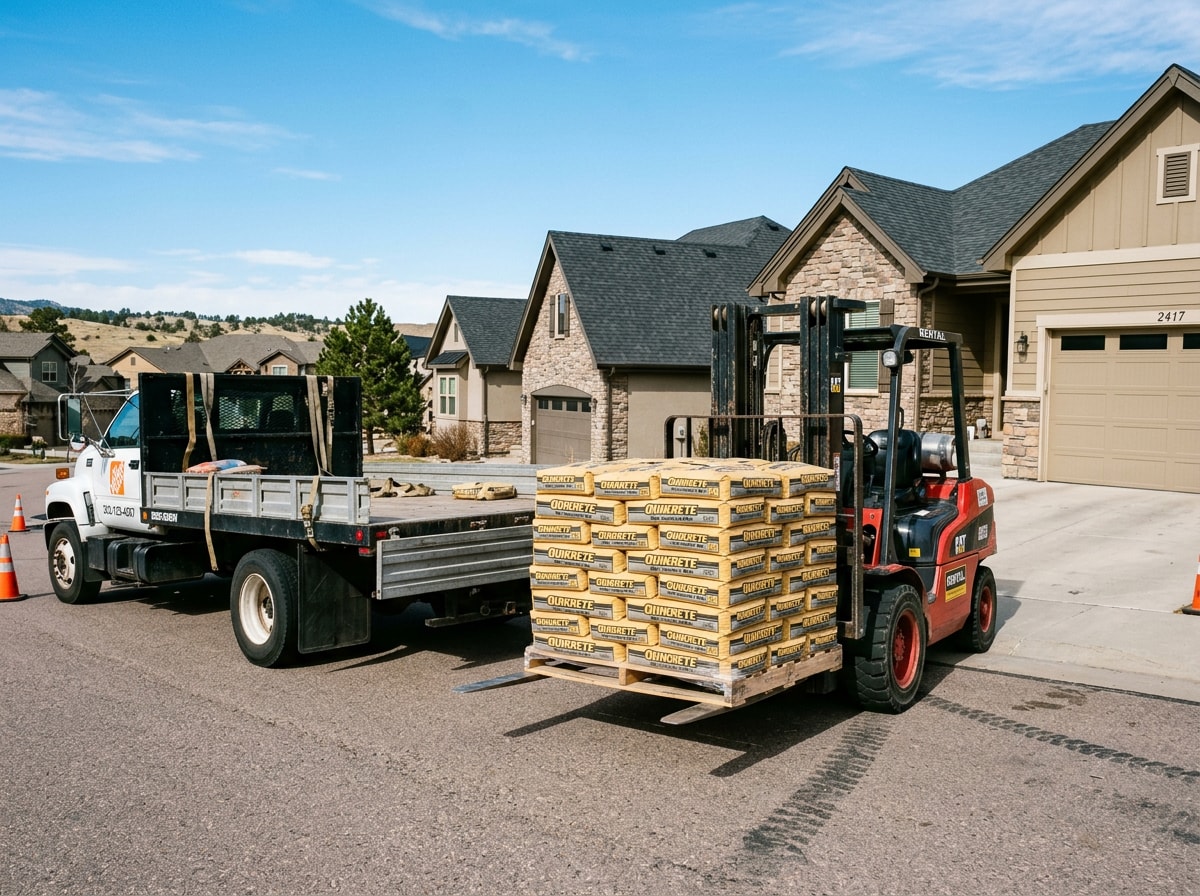
Most concrete pallets ship on a standard 40-inch by 48-inch wood skid. Concrete pallet weight generally tops out near 3,360 lbs of dry material to stay within safe forklift and flatbed handling capacity, plus the weight of the skid itself.
Federal workplace safety rules reflect why suppliers don't stack loaded concrete pallets more than one layer high. Bagged materials shall be stacked by stepping back the layers and cross-keying the bags at least every 10 bags high , per OSHA's general storage requirements under 29 CFR 1926.250. That rule is written for tiered stacking of loose bags, and it's a big part of why a single loaded pallet already sits at the practical safety ceiling for jobsite handling.
Bottom Line
Standard pallet counts run 42 bags for 80 lb mix, 56 bags for 60 lb mix, 64 bags for 50 lb mix, and 80 bags for 40 lb mix. Every configuration lands near the same total weight, which gives you a fast way to compare bag sizes before ordering.
If your project is big enough that you're debating pallets versus a truck, or you want a crew that's placed both bagged and ready-mix concrete across East Metro and Castle Rock driveways, patios, and footings, contact us for a free estimate. You can also browse recent work on our projects page or start from the homepage to see our full service lineup.
For related reading on sealing and maintaining a finished slab in this climate, see our guide to concrete caulking in East Metro & Castle Rock.
FAQ
How many 80 lb bags of concrete are on a pallet?
42 bags, totaling about 3,360 lbs and yielding roughly 0.93 cubic yards once mixed.
How many 60 lb bags of concrete are on a pallet?
56 bags, also about 3,360 lbs total, with the same approximate yield as the 80 lb pallet.
How many 50 lb and 40 lb bags of concrete are on a pallet?
50 lb pallets typically hold 64 bags; 40 lb pallets typically hold 80 bags. Both land around 3,200 lbs total.
How much does a pallet of concrete weigh?
Most full pallets weigh between roughly 3,200 and 3,360 lbs of dry mix, regardless of bag size, since pallets are built around a weight ceiling rather than a bag-count target.
How much concrete does one pallet yield?
A full pallet yields just under one cubic yard of mixed concrete, typically 24 to 25.2 cubic feet depending on bag size. Plan on a little extra for waste and spillage.
How many pallets do I need for a cubic yard?
One cubic yard equals 27 cubic feet. Since a full pallet yields slightly under a yard in every bag size, most one-yard pours need one full pallet plus a handful of loose bags, or two pallets if you want a buffer.
How much does a pallet of concrete cost?
Pricing varies by bag size, mix type, and local supplier, and it shifts with cement and freight costs throughout the year. The most reliable way to get a current number for your East Metro or Castle Rock project is to request a quote directly.