Concrete cutting North Denver & Boulder County, CO requires precise depth control, the right saw for the job, and a plan for Colorado's freeze-thaw cycles. A control joint cut too shallow lets a slab crack randomly through a single hard winter, and a rented blade that binds mid-cut usually ends in a chipped edge or a trip to urgent care. This guide breaks down saw types, wet versus dry cutting, depth rules, safety requirements, and what actually drives cost, so you know what to expect before a crew shows up.
At Pepper's Land Design, our crews have cut control joints and removal lines on driveways from Arvada to Longmont. The most common repair call we get isn't a cracked slab. It's a joint that was cut too shallow the first time.
Browse our concrete installation services to see the full range of residential and commercial work handled across the Front Range.
Why Saw Cutting Matters More in Boulder County
Saw cutting creates controlled openings, joints, and removal lines that concrete won't give up cleanly on its own. A box-store saw with the wrong blade usually produces a wandering line, a cracked edge, or a joint cut to the wrong depth. Those mistakes are expensive to fix after the concrete has cured.
Boulder County concrete sees extra stress from repeated freezing and thawing. That makes accurate joint placement more important here than in milder climates. A slab cut correctly the first time resists random cracking for decades. One cut carelessly can fail within a single winter.
Types of Concrete Saws
Most contractors keep two or three saw categories on the truck, each matched to a different depth, surface, and access requirement.
| Saw Type | Typical Max Depth | Best For |
|---|---|---|
| Walk-behind | 6-8 inches per pass | Long, straight control joints on driveways, sidewalks, parking lots |
| Handheld | 4-6 inches per pass | Curb cuts, pipe and drain openings, trenching, tight repair spots |
| Wall/track-mounted | Up to two feet or more | Deep structural openings, foundation penetrations, large commercial cuts |
Walk-Behind Saws
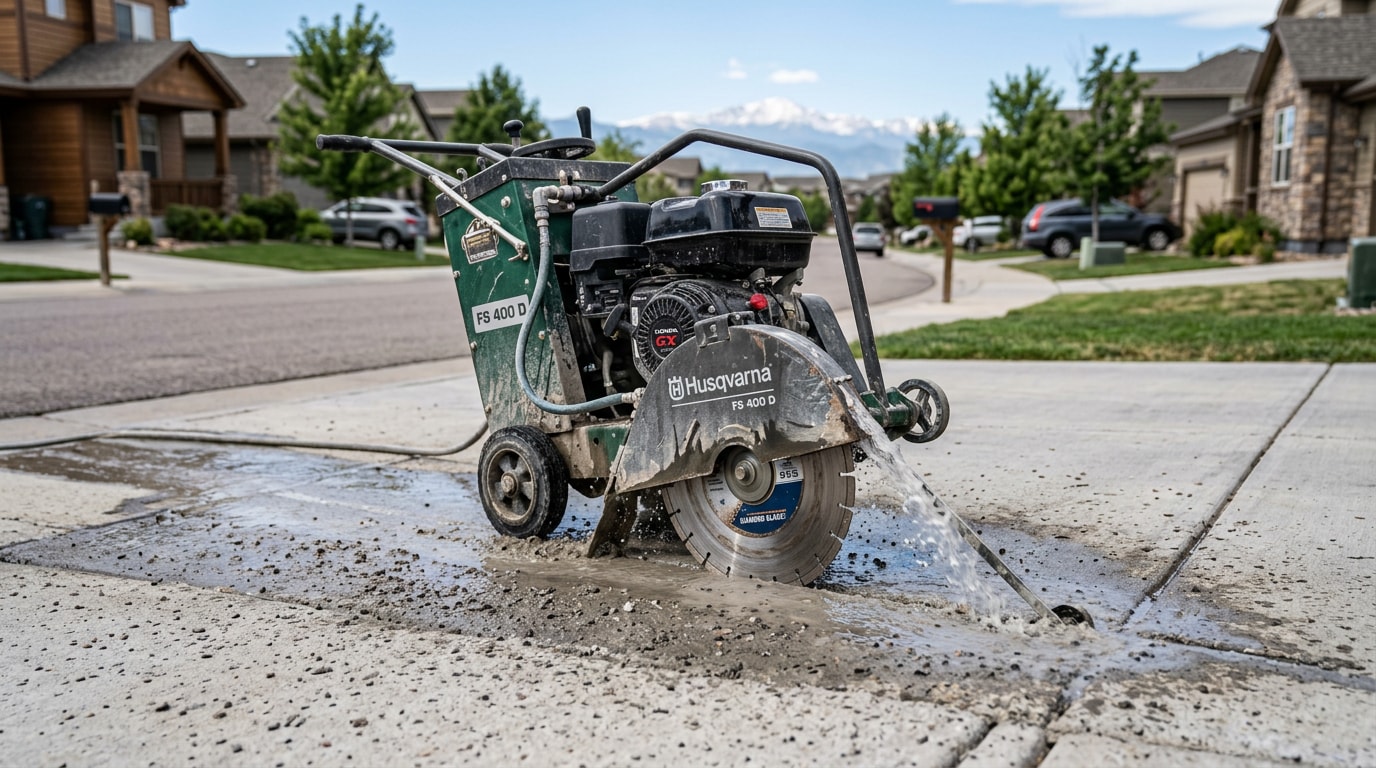
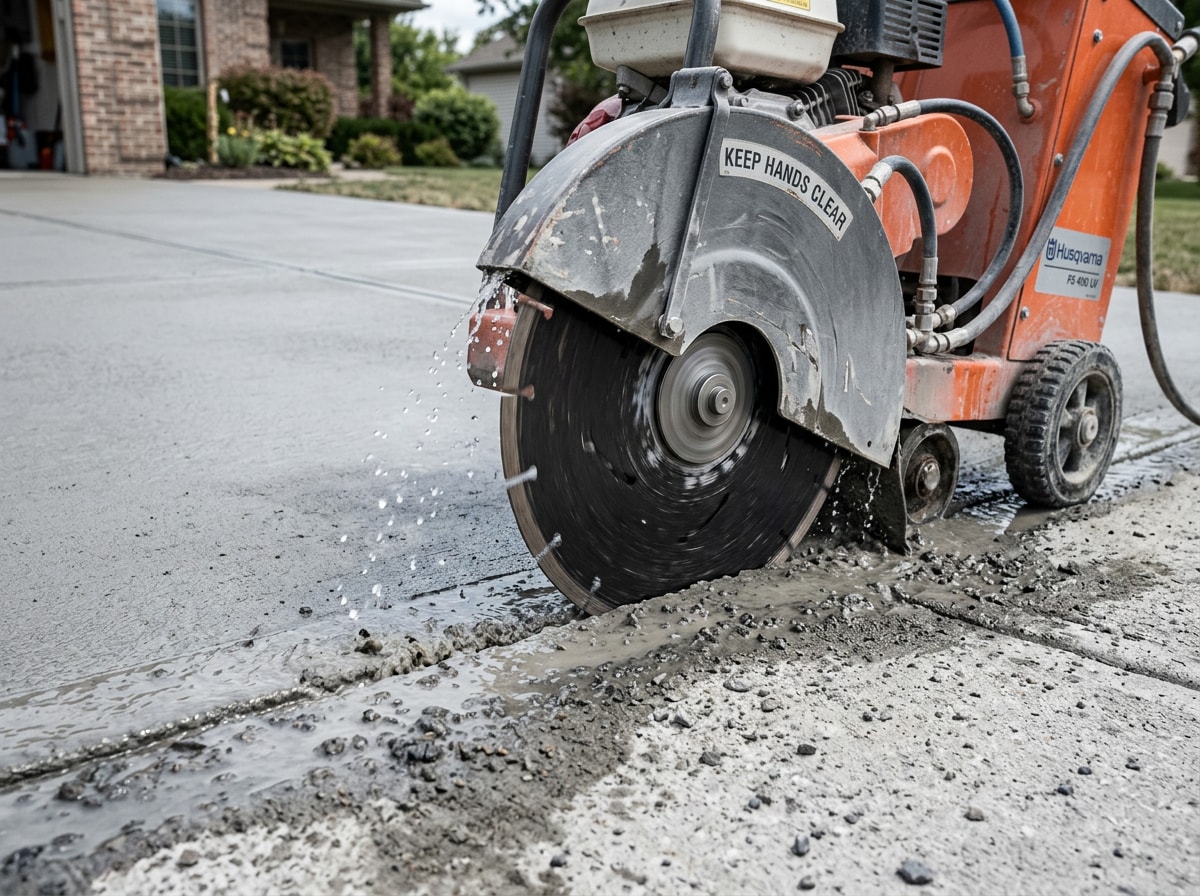
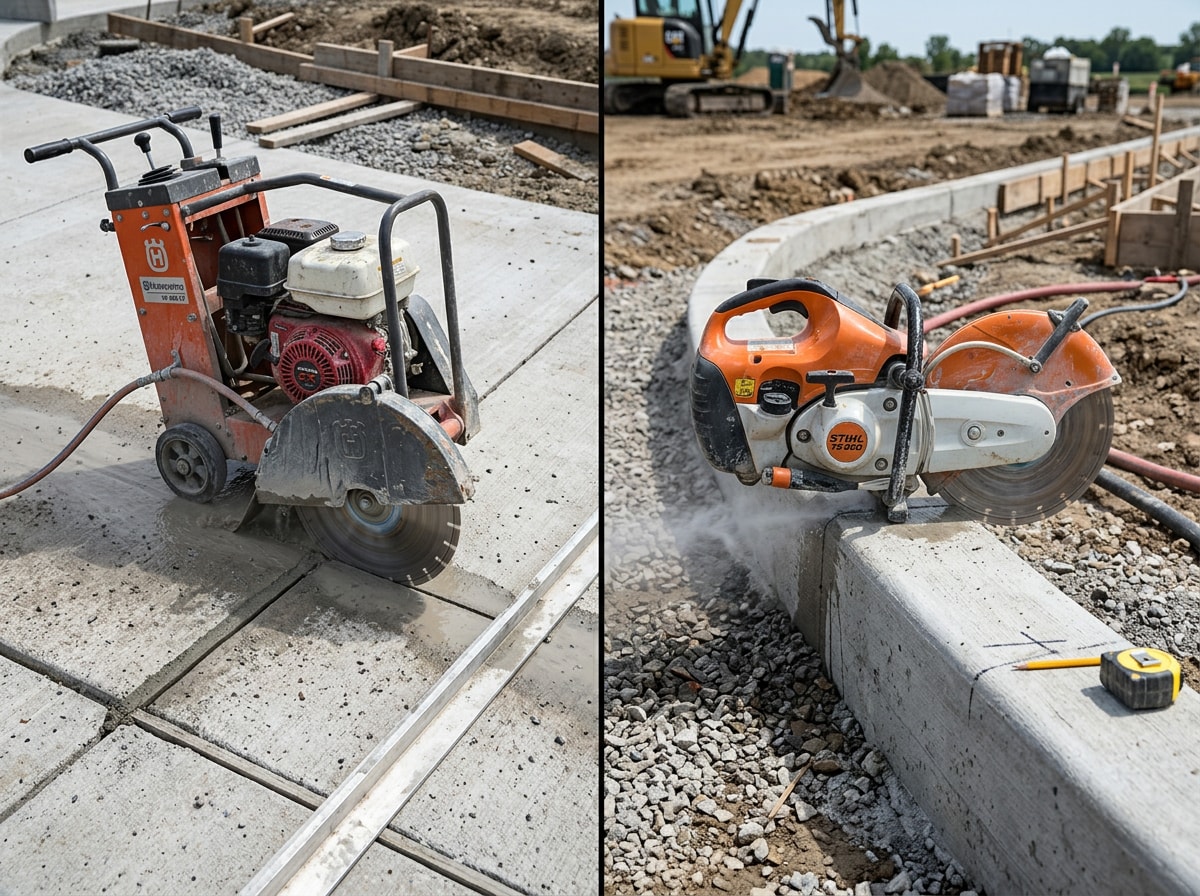
Walk-behind saws are the workhorse for slab cutting on driveways, sidewalks, and parking lots. A gas or electric unit guides a large diamond blade along a straight path, cutting control joints that let concrete expand and contract without random cracking.
Because the operator walks behind the machine instead of carrying it, cuts stay straighter over long runs. That's a real advantage on a 40-foot driveway or a parking lot joint pattern.
Handheld Concrete Saws
Handheld saws trade reach for portability. A technician carries the saw directly, which makes it the right call for curb cutting, small openings around pipes or drains, trenching, and tight spots a walk-behind machine can't reach.
For anything deeper than a single pass allows, crews make multiple passes or switch to a larger walk-behind or wall saw. Handheld saws also shine on repair work, like cutting out one cracked sidewalk panel without disturbing the slabs on either side.
Wet Cutting vs. Dry Cutting
Wet cutting runs a continuous stream of water over the diamond blade during the cut. Dry cutting relies on air cooling and short cutting bursts to keep the blade from overheating. The method a crew chooses depends on the site, the material, and how much dust control the job requires.
Wet cutting handles blade cooling better, which extends blade life and keeps dust down almost entirely, since water binds concrete particles before they go airborne. Dry cutting works better where water access is limited or runoff could stain a finished surface, but it demands tighter dust control through vacuum attachments and shorter cutting intervals.
Colorado's dry climate and freeze-thaw cycles add a wrinkle: water used during wet cutting in cold months can refreeze on a slab surface if cleanup isn't managed carefully, so crews adjust scheduling in winter.
| Factor | Wet Cutting | Dry Cutting |
|---|---|---|
| Dust control | Excellent, water suppresses silica dust | Requires vacuum extraction |
| Blade life | Longer, due to continuous cooling | Shorter, more heat stress |
| Cost | Slightly higher (water setup, cleanup) | Lower upfront, higher blade replacement cost |
| Best use case | Outdoor slabs, driveways, deep cuts | Indoor jobs, water-restricted sites |
| Colorado note | Watch for refreezing in winter | Preferred on dust-sensitive winter jobs |
Step-by-Step: How a Professional Cut Is Made
A professional cut follows the same sequence every time, regardless of saw type. Skipping steps is usually where DIY attempts go sideways.
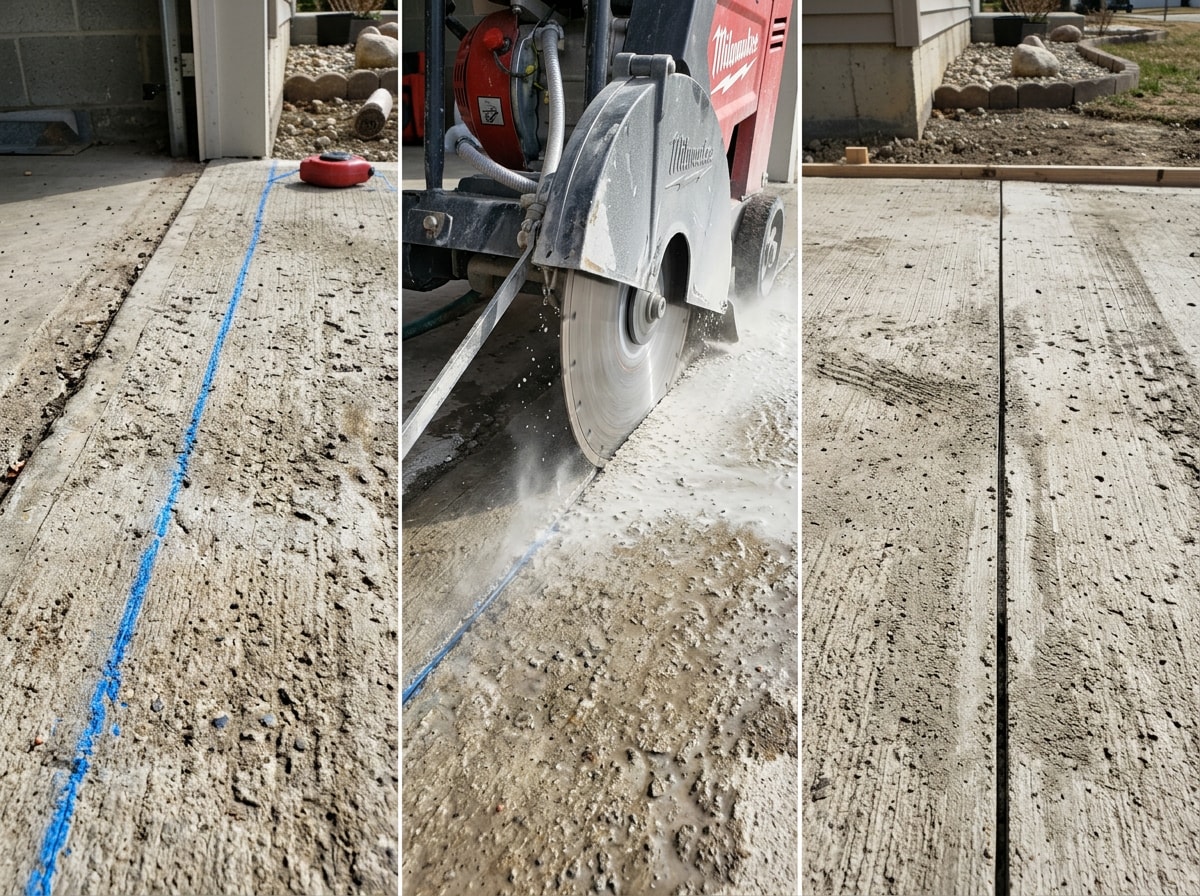
- Mark the line. Every cut starts with a chalk line snapped along the planned path, giving the operator a visible layout to follow once dust starts flying.
- Start at rest. The blade reaches full speed before the operator slowly lowers it into the concrete. Rushing this step is a common cause of a wandering cut or a chipped edge.
- Cut in a single plane. Steady, controlled forward motion, never forcing the saw faster than the blade can comfortably handle.
- Make multiple passes on deep cuts. Experienced operators cut shallow passes rather than hitting full depth in one go, which reduces blade wear and keeps the line straight.
- Never twist or side-load the blade. That's the fastest way to crack a diamond segment or bind the saw mid-cut.
Cutting Depth and Control Joint Spacing
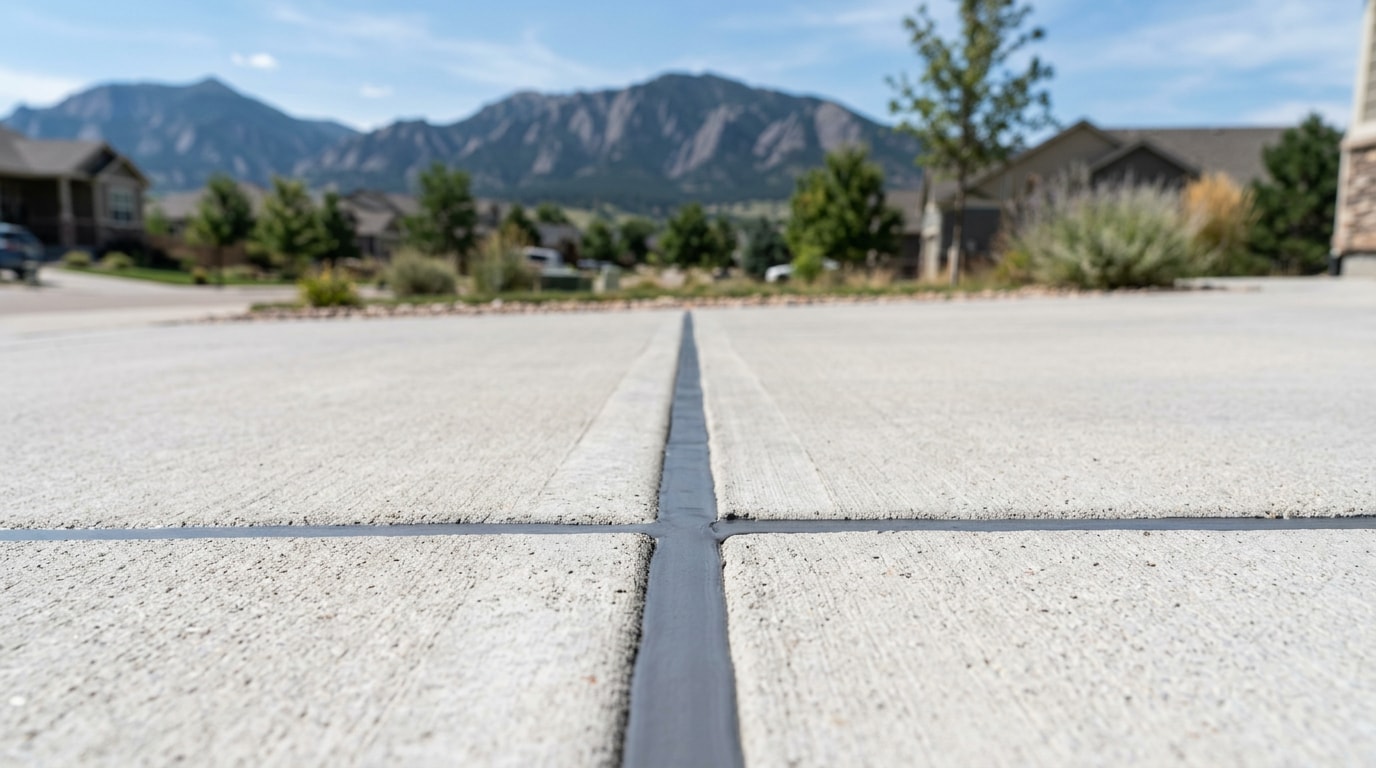
Control joints need to go deep enough to create a weak plane where concrete cracks predictably, without cutting so deep that it compromises load transfer across the joint. A control joint typically requires a groove that is one-quarter times the thickness of the member, with the depth of the groove equal to one-quarter times the thickness of the slab or wall.
Industry guidance also allows a minimum of 1 inch in slabs, but no more than one-third the thickness of the slab.
On a standard 6-inch driveway slab, a control joint cut around 1.5 to 2 inches deep falls in that range, giving the concrete a predictable place to crack while still carrying vehicle loads safely. Cut shallower and the slab may crack randomly somewhere else. Cut deeper and the joint itself can become a weak point.
Joint spacing matters too. Local soil conditions and reinforcement common across Boulder County concrete work can shift that spacing slightly from the textbook number, which is why a site visit beats a phone estimate for anything beyond a simple patio repair.
Dust Control and Silica Safety
Cutting concrete releases fine respirable crystalline silica dust, particles small enough to lodge deep in the lungs. Respirable crystalline silica, very small particles at least 100 times smaller than ordinary sand, is created when cutting, sawing, grinding, drilling, and crushing stone, rock, concrete, brick, block, and mortar.
Work activities such as cutting, grinding, polishing, and drilling can generate dust from materials with RCS that can then become airborne.
Wet cutting suppresses dust at the source by binding particles in water before they become airborne, while dry cutting requires a vacuum extraction system attached directly to the saw. Both methods are accepted ways to meet OSHA's respirable crystalline silica construction standard, which sets exposure limits and specific control requirements for any crew cutting, grinding, or drilling concrete. The CDC/NIOSH silica resource page covers the same hazard from a worker-health angle, including recommended layered controls.
Need a cut planned around dust, drainage, or an HOA restriction? Get a free estimate before a saw ever touches your slab.
PPE Checklist
A basic concrete cutting PPE kit covers five items, and skipping any one of them raises risk fast:
- Safety goggles or a face shield
- Hearing protection
- Heavy-duty gloves
- Steel-toe boots
- A respirator rated for silica dust exposure
A homeowner making one quick cut in a patio slab still needs eye and respiratory protection at minimum, even for a five-minute job. A full crew cutting concrete for an entire shift needs the complete kit plus, often, a half-face respirator rather than a basic dust mask.
What Affects Concrete Cutting Cost in North Denver & Boulder County
Pricing on a cutting job swings on a handful of variables more than on a flat per-foot rate:
- Saw type required. A walk-behind pass for a standard control joint costs far less than a wall-saw opening through a load-bearing foundation.
- Depth and number of passes. Deeper cuts mean more passes, more blade wear, and more time on site.
- Wet vs. dry method. Wet cutting needs water setup and slurry cleanup; dry cutting needs vacuum extraction equipment and more frequent blade changes.
- Access and site conditions. A driveway cut with a truck pulled right up costs less than an interior cut requiring equipment carried through a finished home.
- Disposal. Removal and haul-away of cut concrete sections adds to the total, especially on larger slabs.
- Permitting. Some municipalities in the Denver and Boulder corridor require permits or utility locates before cutting in a right-of-way, which adds lead time rather than cost.
Ask for a line-item quote rather than a flat number so you can see which of these factors is driving your price.
Service Areas We Cover for Concrete Cutting
Concrete cutting North Denver & Boulder County, CO coverage includes Boulder, Longmont, Broomfield, Westminster, Arvada, Louisville, Lafayette, and Thornton. Crews based in this corridor know the specific permitting offices, inspection timelines, and utility-locate requirements each city applies to cutting and removal work.
That local knowledge matters on older infrastructure common throughout the region, where decades of freeze-thaw cycles have already stressed slabs and foundations before a saw ever touches them. It also means faster response time, since crews aren't driving in from across the metro area for every call.
See our full North Denver & Boulder County service area coverage for a community-by-community breakdown. If a decorative concrete project is next on your list, our concrete molds guide for North Denver and Boulder County covers patterns and forms homeowners in this area ask about most.
FAQ
What types of concrete cutting services do you offer?
Core services typically include wall sawing, slab sawing, wire sawing for oversized or reinforced sections, and core drilling for round openings like plumbing or electrical penetrations. Crews also cut custom openings for new doors, windows, and structural modifications. Request a free quote to confirm which services fit your project.
How deep can you cut into concrete surfaces?
Handheld saws typically cut 4 to 6 inches deep per pass, while walk-behind saws reach 6 to 8 inches depending on blade diameter and horsepower. Specialized wall saws cut much deeper on large structural jobs. Most residential slabs only need a fraction of that depth for proper control joints.
Do you perform concrete cutting 24/7?
Emergency concrete cutting is available for urgent situations like utility breaks or time-sensitive commercial deadlines. Most residential and light-commercial jobs run on standard daytime scheduling. Mention a tight timeline when requesting a quote so crews can plan equipment and availability.
How much does concrete cutting cost in North Denver & Boulder County?
Cost depends on saw type, depth, wet versus dry method, access, and disposal needs rather than a single per-foot rate. A short driveway control joint costs far less than a deep wall-saw opening. Request a site visit for an accurate line-item quote.
Can concrete be cut during a Colorado winter?
Yes, but crews plan around it. For a standard 4-inch slab, joints should be cut 1 to 1.5 inches deep, and that work can happen year-round as long as the slab itself isn't frozen through. Wet cutting in freezing temperatures needs extra attention to runoff, since standing water can refreeze on the surface and create a slip hazard.